Nov 18, 2026

Build-up in a 4-3-3

Ready for your next coaching idea.

5
Keeper finds the six, the full-back goes free preview01

Keeper finds the six, the full-back goes free

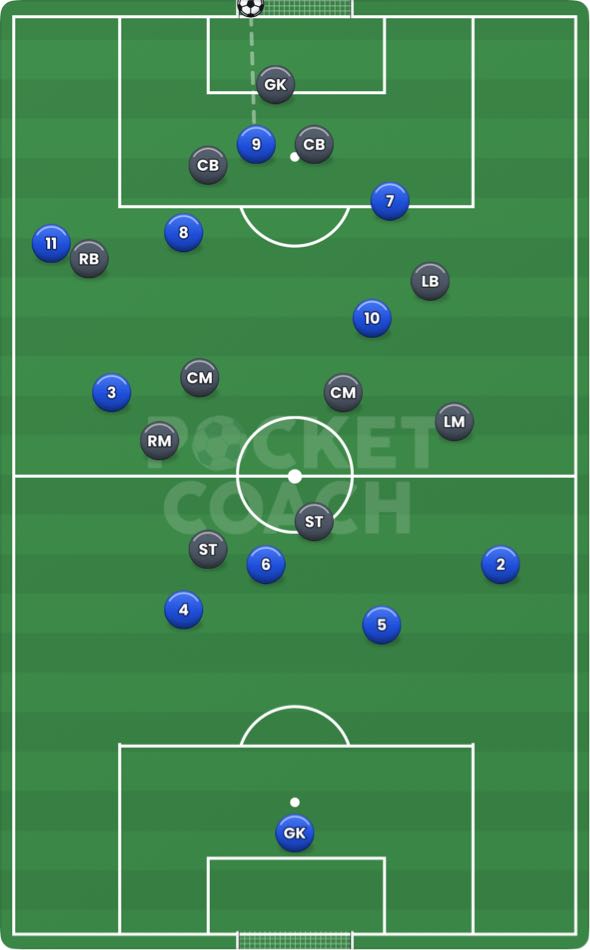
11 v 11 on the full pitch, both keepers. Blue builds up from its keeper in a 4-3-3 and attacks the top goal: the centre-backs split wide to the corners of the box, the full-backs stand wider and higher, the 6 starts in front of them, the eights higher up and the front three pin gray's back four. Gray presses high in a 4-3-3 (role letters): the striker goes at the keeper, the two wide forwards sit between blue's centre-backs and full-backs, the central midfielders watch the eights and jump onto a full-back who gets the ball, the holding midfielder stays in front of his centre-backs, and the full-backs mark blue's wingers near halfway. 5 plays back to the keeper and the striker sprints at him. The keeper stays calm and takes a touch to open a passing angle while the 6 drops to show between the striker and gray's right forward. The pass through the first line pulls that forward inside onto the 6, who sets 4 first time; 4 finds 3, now free on the left, and 3 carries the ball up the line before gray's midfielder gets across: the press is broken. From there the play shows a typical continuation (the clip is not described further): 3 plays inside to 8, who turns and slips 11 in behind gray's right-back, and 11 attacks the box with 9 and 8 arriving. The source describes one match clip; positions follow the textbook 4-3-3 shapes and the opponent's press shape is taken from FIFA's analysis of a 4-3-3 high press, not from the clip. **Coaching points** - Keeper, accept the pressure and open a new angle. - 6, show between the forwards; offer early. - Read who the pass pulls in, then find the free man. - Full-back, stay wide until the forward commits. - Once the press is broken, play forward at once. **Progression** If the press shuts the short options, the keeper reads it and goes long instead (the source's other clips: a long pass onto the centre-forward's chest with support underneath, or a long ball into a forward's diagonal run from out to in). Another option from the same article: the keeper steps up beside his centre-backs to build in a three, so a midfielder can push higher. **Topic** Build-up · **Age** U14+ · **Players** 11 v 11 15 min **Source** Pascal Zuberbuehler for FIFA's Technical Study Group, 'Short goal kicks by outfielders and long passes', FIFA U-17 World Cup Qatar 2025 (analysis of match clips), clip 1 and the intro on first passes to the keeper: https://www.fifatrainingcentre.com/en/game/tournaments/fu17wc/2025/short-goal-kicks-by-outfielders-and-long-passes.php ; gray's press shape from 'How Morocco's 1-4-4-2 build-up challenged Spain's 1-4-3-3 high press' (FIFA U-20 World Cup 2025 analysis)
Goal kick: long to the eight, flick on in behind preview02

Goal kick: long to the eight, flick on in behind

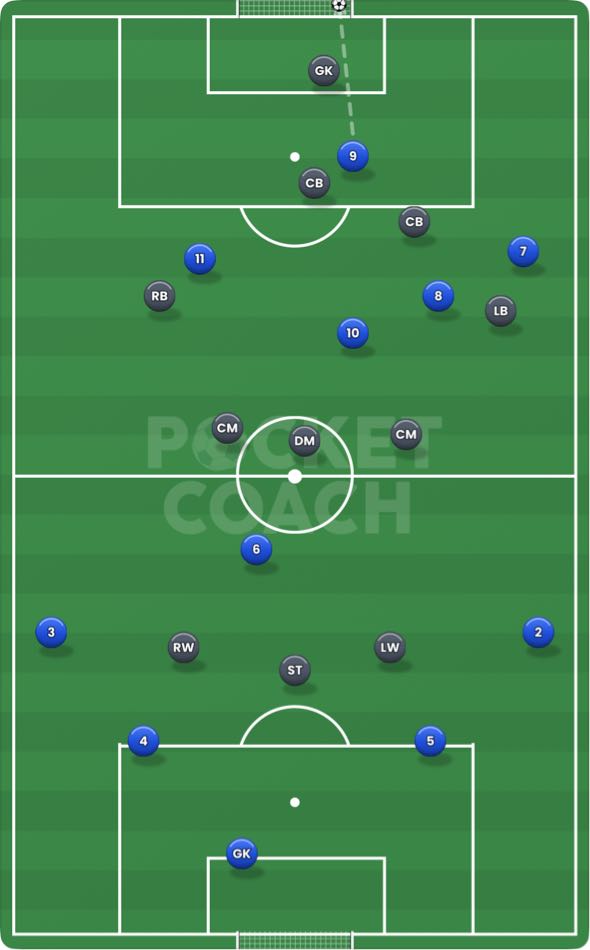
11 v 11 on the full pitch, both keepers. Blue restarts with a goal kick in a 4-3-3 and attacks the top goal; gray presses high in a 4-3-3 (role letters): striker and wide forwards at the edge of blue's box, the midfield behind them, the back four near halfway. Before the kick, the right central midfielder (8) pushes up to the halfway line beside the right winger, so the two stand against gray's left-back alone, while 10 slides across to hold the middle. A centre-back takes the goal kick short to the keeper, which springs gray's front three. The keeper sets the ball with one touch and holds it a moment longer, so gray's midfield squeezes up behind its forwards and leaves space behind them. Then he goes long to 8, who flicks it on with his head into the path of 7, already running in behind the full-back. 7 is through with the 9 and the far-side players arriving; the low ball to the near post and the 9's finish are a typical end (the source notes that many of these keeper-started sequences ended with an attempt at goal). A goal-kick routine described by FIFA's Technical Study Group at the Club World Cup 2025; positions follow the textbook 4-3-3 shapes, the source gives no diagram. **Coaching points** - Invite the press with the short goal kick. - Keeper, one touch to set up the long kick. - 8, attack the ball: hold it or flick it on. - Winger, set off before the header for the flick-on. - Supporting midfielders, run early for the second ball. **Progression** Second variation from the source: the keeper plays the centre-back in the box, he finds the full-back, and the 8 comes short to receive from the full-back instead of waiting high. Another option from FIFA's U-17 World Cup analysis: the keeper strikes a long pass onto the centre-forward's chest, who holds it with his back to goal while a midfielder supports underneath. **Topic** Build-up · **Age** U14+ · **Players** 11 v 11 15 min **Source** FIFA Technical Study Group (Tobin Heath, Pascal Zuberbuehler, Roberto Martinez), 'TSG roundtable: Inverting full-backs, goal kick routines and goalkeeper distribution', FIFA Club World Cup 2025 (analysts' observations), section on goal-kick routines: https://www.fifatrainingcentre.com/en/game/tournaments/fcwc/2025/team-analyses/tsg-roundtable-inverting-full-backs-goal-kick-routines-and-goalkeeper-distribution.php ; flick-on and support runs: 'Short goal kicks by outfielders and long passes' (FIFA U-17 World Cup 2025), clip 4

Left-back steps inside into the ten's space preview03

Left-back steps inside into the ten's space

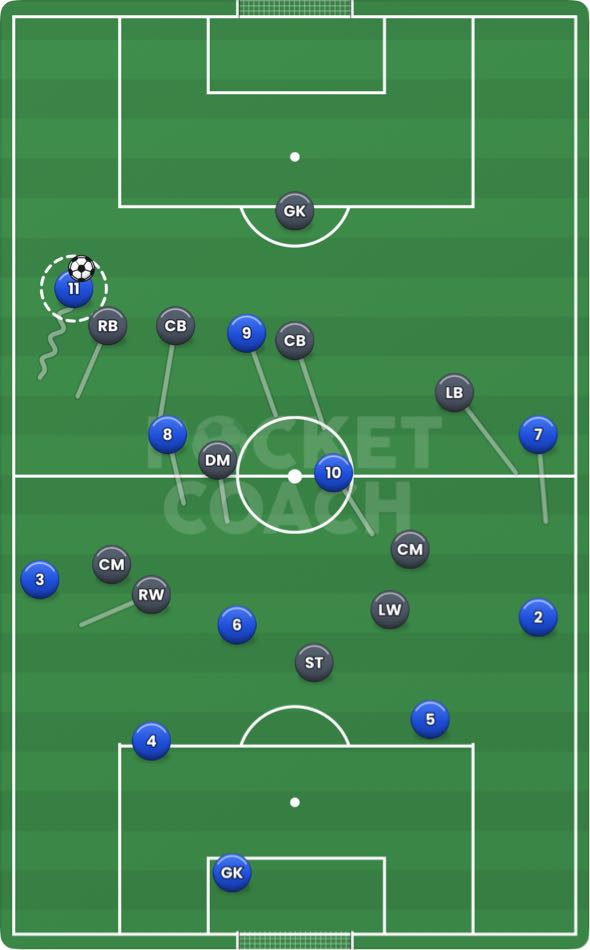
11 v 11 on the full pitch, both keepers. Blue is in settled possession in its own half in a 4-3-3 and attacks the top goal: centre-backs wide apart, the 6 in front of them, the eights between gray's lines, the wingers high and wide. Gray defends in a 4-4-2 mid-block (role letters) with its front two just inside blue's half. Blue circulates from the keeper through 5 and the 6 to 4. When the ball goes across to 4 and gray's front two shift over, the left-back leaves the back line and moves into the inside-left channel behind gray's strikers, while the right-back tucks in so 2, 5 and the 6 keep the balance behind the ball and 11 holds the touchline. 4 steps in with the ball to fix the striker, then plays into the left-back, who turns and carries the ball into the space a number 10 would use. Gray's central midfielder and right-back are drawn inside, so the left-back slips 11 down the line, one against one with the full-back; 11's cross and the 9's finish are a typical end. FIFA's Technical Study Group describes this full-back movement at the Club World Cup 2025; the circulation before it, the team-mates' balancing runs, the finish, the opponent and all positions are textbook estimates, the source gives no diagram. **Coaching points** - Full-back, leave the line once the ball goes across. - Receive in the inside channel already half-turned. - Behind the ball, keep three players for balance. - Winger, hold the touchline to keep the space open. **Progression** The TSG gives the same movement for other left-backs at the tournament, some reaching the edge of the box. A harder version: the inverted full-back combines with the eight and the 9 in the centre instead of releasing the winger. **Topic** Build-up · **Age** U14+ · **Players** 11 v 11 15 min **Source** FIFA Technical Study Group (Tobin Heath, Pascal Zuberbuehler, Roberto Martinez), 'TSG roundtable: Inverting full-backs, goal kick routines and goalkeeper distribution', FIFA Club World Cup 2025 (analysts' observations), section on full-backs: https://www.fifatrainingcentre.com/en/game/tournaments/fcwc/2025/team-analyses/tsg-roundtable-inverting-full-backs-goal-kick-routines-and-goalkeeper-distribution.php

Draw them right, switch through the six preview04

Draw them right, switch through the six

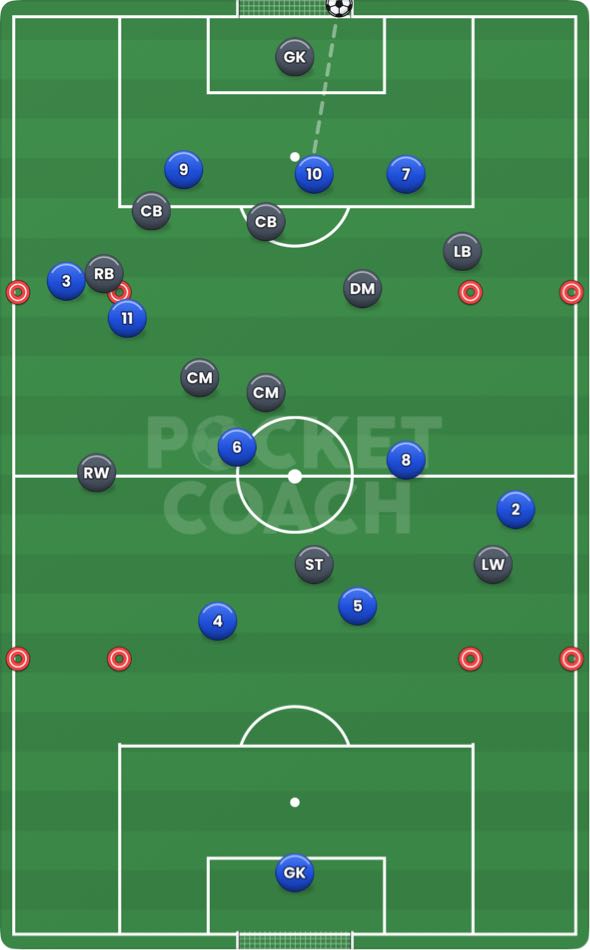
11 v 11 on the full pitch, both keepers. Both teams play a 4-1-2-3 (blue the taught team, gray in role letters). Markers show a 52 x 40 m central zone across halfway and two 14 m lateral zones on either side of it, so the pitch has three central zones (own third, middle, final third) between two wide channels. Blue builds up from its keeper and scores 5 for a goal after playing through all three central zones, 1 for any other goal; once blue enters the final third, gray's back line may not follow or block, and nobody may go offside. Gray presses in a mid-to-high block. The keeper finds the right-back; gray's left winger jumps him, so 8 comes towards the ball and bounces it back to 5. 5 finds the 6, who turns away from his marker and switches to 11 on the far side, while 7 leaves the right touchline for the space inside gray's left-back and the left-back 3 overlaps. 11 carries inside, the 9 runs into the left channel behind gray's right-back, and the cut-back finds 10 arriving at the penalty spot. One typical possession; positions follow the source's diagram, measured approximately. **Coaching points** - Stuck on one side? Play inside, then switch. - Ball on one wing: far winger attacks the gap inside the full-back. - 9 runs in front of or behind the centre-back. - Third man: bounce it back to find the free player. - Use the full width and depth to open passing lanes. **Progression** Variation from the source: gray's defenders may drop back into the final third and stop the attack, so blue must finish faster. When 7 has the ball instead, he goes 1v1, the 9 drops between the centre-backs to combine, 10 runs into the 9's space in behind and 11 makes an L-shaped run inside. **Topic** Build-up · **Age** U14+ · **Players** 11 v 11 25 min **Source** Cristian Flores (Mexico U-15), 'Possession and switch of play', FIFA Training Centre elite session plan (a coach's session), part 3 '11v11 - zonal circulation under pressure', pp. 4-5: https://www.fifatrainingcentre.com/media/native/test/FIFA_Session_Plan_Flores.pdf

Drop in for 6v5, then break in for 4v3 preview05

Drop in for 6v5, then break in for 4v3

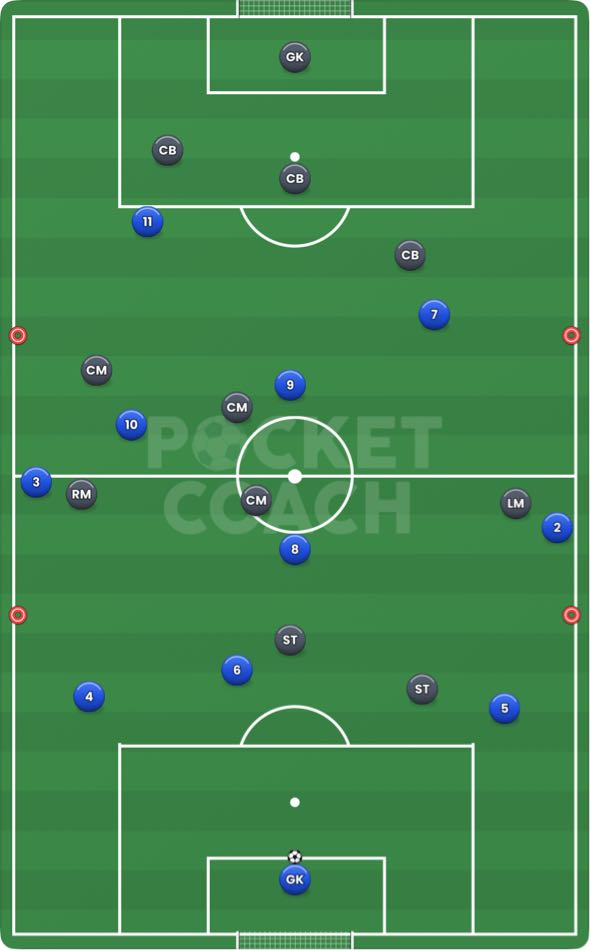
11 v 11 with both keepers on a pitch split into three zones: a back zone, a middle zone and a final zone (the source uses a 65 m octagon with zones of 20, 25 and 20 m; here the zones are stretched to the full pitch, markers on the touchlines show the zone lines). Each team spreads 3 players in its back zone, 5 in the middle and 2 up front. Blue's 4-3-3 does it like this: 5, 6 and 4 in the back zone, the 6 dropping between the centre-backs; the full-backs, 8, 10 and the 9 in the middle zone; the wingers 7 and 11 in the final zone. Gray (role letters) does the same with 3 defenders, 5 midfielders and 2 forwards. Rules: from the back zone the ball may only go into the middle zone; one forward may drop into the middle zone for a 6v5, and once the ball reaches the final zone two middle-zone players may join for a 4v3. Blue starts with the keeper: 4 draws a forward, and the ball goes through the 6 to 5 (the session's earlier passing pattern), who carries it to the edge of the back zone. 7 drops to receive from 5 and lays it off into the final zone for the right-back, who has run past him; the right-back carries in, the 9 joins him and finishes from the cut-back. One typical possession; the back-zone circulation is a typical start, the rest follows the source's diagram, measured approximately and stretched to the full pitch. **Coaching points** - Pass into the middle, then think forward at once. - Offer at the right moment and call for the ball. - Overload the dangerous zone with timed runs. - Break the line with precise, well-weighted passes. **Progression** The session then moves on to 11 v 11 on a 70 m pitch without zones, where the team that loses the ball must sprint back into its own half before it defends, while the other team counter-presses straight away. **Topic** Build-up · **Age** U14+ · **Players** 11 v 11 20 min **Source** Michel Renggli (FC Luzern), 'Vertical progressive play', FIFA Training Centre elite session plan (a coach's session), part 3 '11v11 in an octagon with 3 zones', pp. 5-6: https://www.fifatrainingcentre.com/media/native/test/FIFA_Session_Plan_Renggli.pdf