---
title: "Defensive Fronts and Run Fits | Pocket Coach"
description: "Defensive Fronts and Run Fits"
canonical_url: "https://pocket-coach.net/americanfootball/playlists/880d1b02-bc9b-4fdc-9fc9-5dadd5bd20aa"
meta:
"og:description": "Defensive Fronts and Run Fits"
"og:image": "https://s3.eu-central-1.amazonaws.com/pocketcoachamericanfootball/ee3949e1-2bbc-499b-8f03-8e2886bf21461794572198.jpeg"
"og:title": "Defensive Fronts and Run Fits"
---
> Index of every page on this site: [llms.txt](https://pocket-coach.net/llms.txt)
Nov 26, 2026
# Defensive Fronts and Run Fits
Ready for your next coaching idea.
**19**
[Copy to Library](https://pocket-coach.net/app/americanfootball/playlists/new?sourceId=880d1b02-bc9b-4fdc-9fc9-5dadd5bd20aa&kind=library&featured=true&from=public) [Create plan](https://pocket-coach.net/app/americanfootball/playlists/new?sourceId=880d1b02-bc9b-4fdc-9fc9-5dadd5bd20aa&kind=plan&featured=true&from=public)
[014-3 Over Run Fits
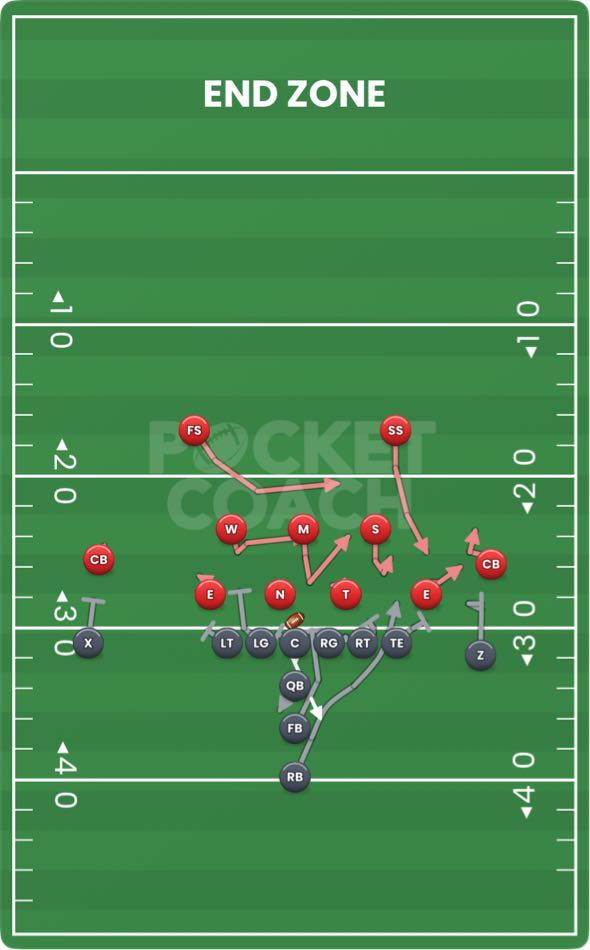
Tackle football, 11 v 11 on the half field, ball on the 30. Defense: 4-3 Over with a Cover 2 shell. The Mike calls the closed (tight end) side, here right, and the front sets to it: closed-side end in a 7-technique outside the tight end, the defensive tackle in a 3-technique on the outside shoulder of the closed-side guard, the nose in a 0-shade on the open side of the center, open-side end in a 5-technique. The linebackers stack tackle-zero-tackle about 4-5 yards deep, both corners squat at 5-6 yards, safeties 13-14 yards deep. One gap each against the run: closed side, the end owns the D gap, the Sam the C gap, the 3-technique the B gap, the Mike the A gap; open side, the nose the A gap, the Will the B gap, the end the C gap. In Cover 2 the corners force (turn the ball inside) and the safeties fill the alley. Offense: Pro I (tight end and flanker right) running iso at the closed-side A gap. Shown: the Mike meets the fullback in the hole, the back bends outside, the Sam fills the C gap and the strong safety and the Will close for a two-yard gain. Display splits are widened; depths, the offense's blocks and the gain are our illustration. \*\*Coaching points\*\* - Know your gap before the snap, attack it at the snap. - Linebackers: read the backs, then fill downhill. - Squeeze the hole, spill the back to help. - Corners: force, keep the ball inside. - Backside players: pursue inside-out for the cutback. \*\*Topic\*\* Run defense and plays · \*\*Age\*\* U14+ · \*\*Players\*\* 11 v 11 · \*\*Phase\*\* Main part \*\*Source\*\* Matt Bowen, 'NFL 101: The Basics of the 4-3 Defensive Front', Bleacher Report, https://bleacherreport.com/articles/1999358-nfl-101-the-basics-of-the-4-3-defensive-front (4-3 Over: 3-technique to the closed side, nose 0-shade/2i open side, closed-side end 7-technique, tan-zero-tan linebackers, Pro I gap fits and the Cover 2 shell); one-gap rules also in ViQtory Sports '4-3 Defense Install Guide', https://www.viqtorysports.com/?p=819Open ↗](https://pocket-coach.net/americanfootball/plays/ee3949e1-2bbc-499b-8f03-8e2886bf2146)
[024-3 Under Run Fits
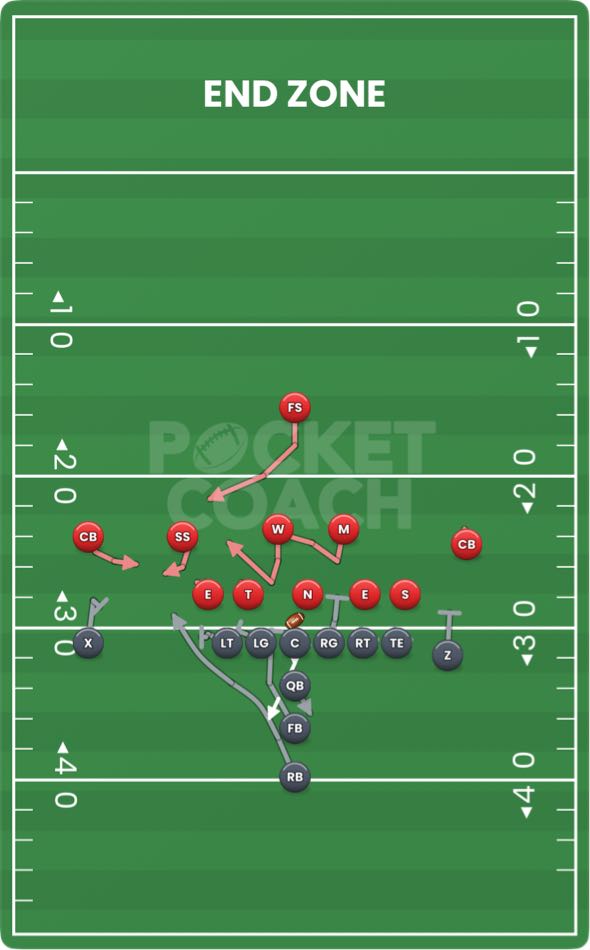
Tackle football, 11 v 11 on the half field, ball on the 30. Defense: 4-3 Under with Cover 3 behind it and the strong safety walked down on the open side. The front sets to the closed (tight end) side, here right: the Sam on the line over the tight end, the closed-side end kicked down over the right tackle, the nose in a 0-shade on the closed side of the center, and the 3-technique on the open-side guard, with the open-side end outside the left tackle. The Mike and the Will sit in the bubbles 4-5 yards deep: Mike over the closed-side B gap, Will over the open-side A gap. Gap fits: closed side, the Sam owns the D gap, the end the C gap, the Mike the B gap, the nose the A gap; open side, the Will the A gap, the 3-technique the B gap, the end the C gap, and the down safety tracks the fullback and forces any run that bounces outside. The free safety plays the middle third, both corners the outside thirds. Offense: Pro I right with the flanker in a tight split, running a lead to the open side. Shown: the Will meets the fullback in the A gap, the 3-technique holds, the back bounces outside and the down safety and the end tackle him for a one-yard gain. Display splits are widened; depths, the offense's blocks and the gain are our illustration. \*\*Coaching points\*\* - Under: nose and Sam to the tight end, 3-technique away. - Bubble linebackers: read the backs, fill your gap fast. - Down safety: track the fullback, force outside-in. - Squeeze your gap with your outside arm free. - Everyone else: pursue inside-out, no cutback lanes. \*\*Topic\*\* Run defense and plays · \*\*Age\*\* U14+ · \*\*Players\*\* 11 v 11 · \*\*Phase\*\* Main part \*\*Source\*\* Matt Bowen, 'NFL 101: The Basics of the 4-3 Defensive Front', Bleacher Report, https://bleacherreport.com/articles/1999358-nfl-101-the-basics-of-the-4-3-defensive-front (4-3 Under: nose 0-shade to the closed side, 3-technique open side, closed-side end over the tackle, Sam walked up on the tight end, Mike and Will in the bubbles, Pro I gap fits, 'Under 10' safety tracking the fullback); gap table also in ViQtory Sports '4-3 Defense Install Guide', https://www.viqtorysports.com/?p=819Open ↗](https://pocket-coach.net/americanfootball/plays/e69efe2e-f450-4472-89f8-afccd98698ba)
[033-4 Okie Run Fits
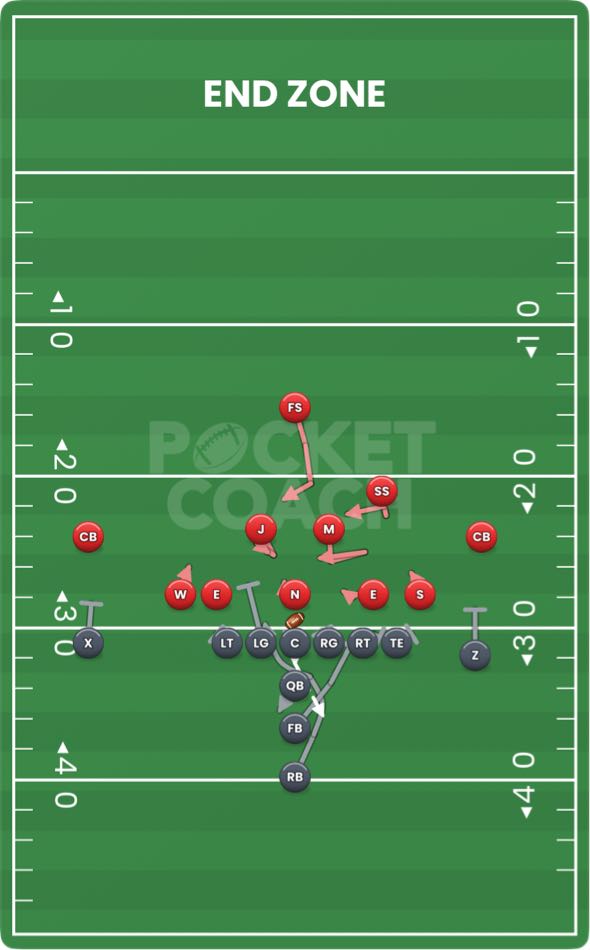
Tackle football, 11 v 11 on the half field, ball on the 30. Defense: 3-4 Okie (the traditional two-gap 3-4) with Cover 3 sky behind it. The nose plays head-up on the center (0-technique) and owns both A gaps, the ends play head-up to the outside shoulder of the tackles (5-technique) and two-gap the B and C gaps: strike, lock out the blocker, find the ball, then shed into the gap it goes to. Because the linemen two-gap, the inside linebackers (Mike to the tight end, Jack away) stand over the uncovered guards about 4-5 yards deep and fill wherever the ball goes. The outside linebackers are on the line: the Sam outside the tight end (7-technique) and the Will on the open side (6-technique); both set the edge and play cutback and bootleg. Strong safety rolled down to the tight end side at 8-9 yards, free safety in the middle third, corners in the outside thirds. Offense: Pro I right running iso at the closed-side B gap. Shown: the end sheds into the B gap, the Mike fills over the top, the back cuts back and the nose and the Jack close the A gap for a one-yard gain. Display splits are widened; depths, the offense's blocks and the gain are our illustration. \*\*Coaching points\*\* - Linemen: strike, lock out, find the ball, then shed. - Nose: control the center, own both A gaps. - Inside linebackers: fill fast where the ball goes. - Outside linebackers: set a hard edge, never get reached. - Backside: stay home for cutback and bootleg. \*\*Topic\*\* Run defense and plays · \*\*Age\*\* U14+ · \*\*Players\*\* 11 v 11 · \*\*Phase\*\* Main part \*\*Source\*\* Matt Bowen, 'NFL 101: The Basics of the 3-4 Defensive Front', Bleacher Report, https://bleacherreport.com/articles/2007958-nfl-101-the-basics-of-the-3-4-defensive-front (base 3-4 'Okie': nose 0-technique for both A gaps, ends 5-technique two-gapping B and C, inside linebackers over the uncovered guards, Sam 7-technique and Will 6-technique on contain, cutback and boot); two-gap alignment also in Scouting Academy 'ITP Glossary: 3-4 Base Defense', https://scoutingacademy.com/itp-glossary-3-4-base-defense/Open ↗](https://pocket-coach.net/americanfootball/plays/2f488946-09b0-4e78-ad7a-fde06d2cb183)
[04Nickel 4-2-5 Run Fits
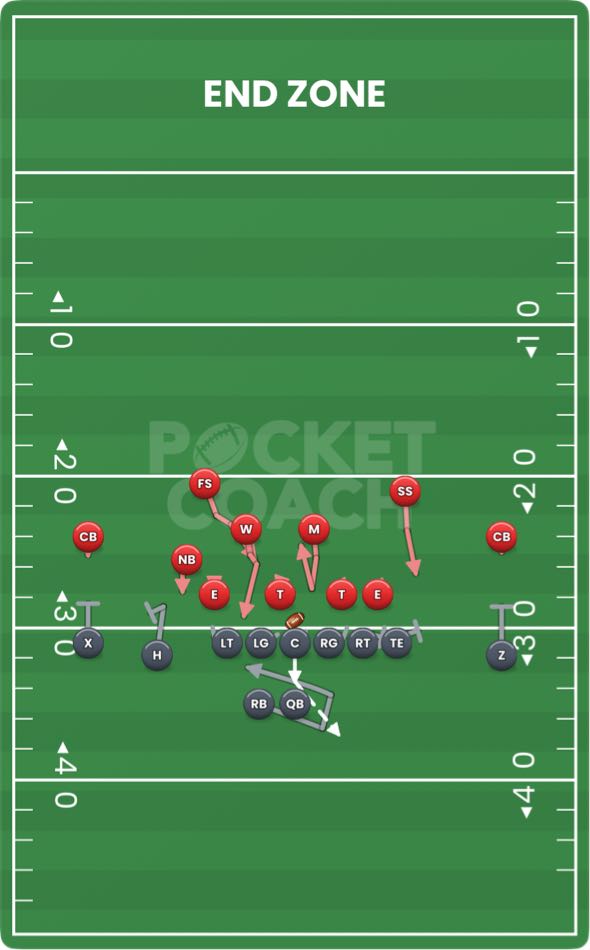
Tackle football, 11 v 11 on the half field, ball on the 30. Defense: Nickel 4-2-5 (four linemen, two linebackers, five defensive backs) in an Over front with quarters behind it, against 11 personnel. The 3-technique goes to the tight end and owns the B gap, the other tackle is a 1-technique on the backside A gap, both ends are 5-techniques outside the tackles and own the C gaps. The two linebackers stack 4-5 yards deep and own the uncovered gaps: Mike the tight-end-side A gap, Will the open-side B gap. The nickel plays at apex between the left tackle and the slot: he squeezes the C gap from outside and forces anything that bounces his way. The safeties sit 9-10 yards deep and fill the alleys as soon as they read run, and the corners play the deep quarters outside them. Offense: gun 2x2 with a tight end, running inside zone to the tight end. Shown: the 3-technique and the Mike close the front side, the strong safety fills outside, the back cuts back and the Will, the backside end, the nickel and the free safety stop him at the line. Display splits are widened; depths, the offense's blocks and the result are our illustration. \*\*Coaching points\*\* - Two linebackers: own your gap, no free runs. - Nickel: squeeze from outside, force the bounce back. - Quarters safeties: read run, fill the alley fast. - Backside end: squeeze, stay home for the cutback. - Tackle like a linebacker, cover like a corner. \*\*Topic\*\* Run defense and plays · \*\*Age\*\* U14+ · \*\*Players\*\* 11 v 11 · \*\*Phase\*\* Main part \*\*Source\*\* ViQtory Sports, '4-2-5 Defense Install Guide', https://www.viqtorysports.com/4-2-5-defense-football-coaching-guide/ (Over front: 3-technique to the tight end on the B gap, 1-technique A gap, 5-technique ends on the C gaps, two linebackers on the A and B gaps, quarters: corners and safeties deep quarters, safeties in the run fit); CFBTrack '4-2-5 Nickel: Formation Diagram & Guide', https://cfbtrack.com/football-formations/defense/4-2-5-nickel (fifth defensive back as nickel / overhang, inside fits depend on the two linebackers)Open ↗](https://pocket-coach.net/americanfootball/plays/03428ae1-82ec-41f8-bf53-015d91cf9ac8)
[0546 Bear Front Run Fits
Tackle football, 11 v 11 on the half field, ball on the 30. Defense: the 46 'Bear' front, eight men in the box against a Pro I (tight end and flanker right). The center and both guards are covered: a nose over the center, the strong-side end on the outside shoulder of the right guard, the weak-side tackle on the outside shoulder of the left guard, and the weak-side end one to two yards outside the left tackle. Two outside linebackers stand on the tight end, the Jack outside him and the Charlie inside him; the Mike sits about 4-5 yards deep over the strong tackle and the strong safety at the same depth over the weak tackle, so he plays like a linebacker. One free safety deep over the weak guard, both corners in bump-and-run man. Against the run the covered linemen hold their gaps and stop the offensive line from doubling or climbing, the edges squeeze the ball inside, and the linebackers run free to it. Shown: iso at the weak-side A gap, the one gap the front leaves open; the strong safety meets the fullback there, the back bounces outside and the Mike and free safety finish for a short gain. Display splits are widened; the gap each defender fits, the offense's blocks and the gain are our illustration. \*\*Coaching points\*\* - Covered linemen: lock your blocker, own your gap. - Weak-side end: squeeze and keep contain. - Fill the open A gap downhill, take on the lead. - Mike: read flow, run free to the ball. - Corners: bump and run, then turn runs inside. \*\*Progression\*\* Pressure from the front: send the Jack or the strong safety and drop the other. Against three receivers use the 'Jayhawk' adjustment (the Charlie moves to the Mike's spot, the Mike to the strong safety's, the strong safety covers the slot). Modern teams borrow only the Bear interior (nose plus two 3-techniques) with any coverage behind it. \*\*Topic\*\* Run defense and plays · \*\*Age\*\* U14+ · \*\*Players\*\* 11 v 11 · \*\*Phase\*\* Main part \*\*Source\*\* Wikipedia, '46 defense', https://en.wikipedia.org/wiki/46\_defense (alignment against a Pro set: weak end 1-2 yards outside the weak tackle, weak tackle and strong end on the guards' outside shoulders, nose over the center, Jack outside and Charlie inside the tight end, Mike 4-4.5 yards over the strong tackle, strong safety 4-4.5 yards over the weak tackle, free safety 10-12 over the weak guard, corners bump-and-run; Jayhawk adjustment); Football Advantage, '46 Defense', https://footballadvantage.com/46-defense/ (same covered interior, gap duties: nose A, weak tackle and strong end B, weak end C and contain, the off-ball linebacker on the weak side fits the open A gap, corners and free safety turn runs inside); Football Nation USA, 'What Is a Bear Front?', https://www.footballnationusa.com/post/what-is-bear-front-football-defenseOpen ↗](https://pocket-coach.net/americanfootball/plays/9c04f1ae-5af1-4c68-9bc3-93ed5785ed1c)
[06Tite Front Run Fits
Tackle football, 11 v 11 on the half field, ball on the 30. Defense: the Tite front, a modern one-back answer built from the Bear idea: the nose head-up on the center (0-technique) and both ends on the inside shoulders of the tackles (4i), with two inside linebackers 4-5 yards deep behind the guards. Two edge players stand on the line outside the front, the Jack outside the left tackle and the Sam outside the tight end; the strong safety is down over the slot, the free safety in the deep middle, the corners on the outside receivers. Offense: shotgun 11 personnel 2x2 with the tight end right, running inside zone to the tight end. The linemen 'react and attack': they play through the man in front of them and only then chase the ball, so the guards and the center can't leave their double teams. That keeps both linebackers free. Shown: the right 4i holds the guard and the tackle, the Mike fills the front-side A gap, the back cuts back, the nose and the left 4i squeeze, and he bounces into the Jack and the Will for a short gain. The edge alignments, the coverage behind and every gap fit are our textbook illustration, not a team's playbook. \*\*Coaching points\*\* - Ends: hands inside, read the tackle's hip. - Nose: play the center, fall back to the cutback. - Make the double team stay on you. - Linebackers: read flow, run free to your gap. - Edges: squeeze, then spill the bounce to help. \*\*Progression\*\* Add a nose slant: when the nose slants strong, the Mike becomes the flow player and the Will owns the backside A gap. With smaller linemen, slant the 4i ends into the B gaps for penetration instead of reacting. Swap the down safety for a stacked third linebacker for the 'stacked' version of the front. \*\*Topic\*\* Run defense and plays · \*\*Age\*\* U14+ · \*\*Players\*\* 11 v 11 · \*\*Phase\*\* Main part \*\*Source\*\* Throw Deep Publishing, 'Coaching Tite Front Run Fits: What You Need To Know' (clinic notes with coach Tyler Manes), https://throwdeeppublishing.com/blogs/news/the-tite-3-4-defense-what-you-need-to-know (two 4i ends and a 0-technique nose, inside linebackers at depth behind the guards or stacked; React-Attack: the end reads the tackle's inside hip through hands and hips; nose 'board drill', lag to the cutback or slant, with the Mike as flow player and the Will on the backside A gap on a strong slant; the Tite as the one-back version of the Bear front that keeps the linebackers free from double teams); Football Nation USA, 'What Is a Bear Front?', https://www.footballnationusa.com/post/what-is-bear-front-football-defense (Tite = nose over the center and ends on the tackles' inside shoulders, 4i-0-4i; crowding the interior makes inside zone doubles and climbs harder)Open ↗](https://pocket-coach.net/americanfootball/plays/1b408111-7e38-402a-9e9c-b87dde5e3a6d)
[07Scrape Exchange vs Zone Read
Tackle football, 11 v 11 on the half field, ball on the 30. Defense: nickel 4-2-5 with Cover 1 behind it, the strong safety rolled down over the tight end: ends outside the tackles, the nose on the left shoulder of the center, a 3-technique on the right guard, the Will and the Mike 4-5 yards deep, the nickel over the left slot, corners on the wide receivers, the free safety deep in the middle. Offense: shotgun 11 personnel 2x2 (tight end right) running the zone read: the line zone-steps right, the back runs inside zone right and the left end is left unblocked for the QB to read through the mesh. The run fit is the scrape exchange: the end trades jobs with the Will. The end crashes flat down the line and takes the back on the dive; the Will scrapes over the top to the outside and owns the QB. The QB reads the crash, pulls the ball and runs into the Will for a loss. The front, the coverage, the spacing and the loss are our illustration of the technique. \*\*Coaching points\*\* - End: crash flat down the line at the dive. - Will: scrape over the top the moment the end crashes. - Take the QB with outside leverage, never from behind. - Mike: fill the front-side gap for the dive. - Change the exchange call so the QB can't trust his read. \*\*Progression\*\* Show the give: the end slow-plays the mesh, the QB hands off and the end folds back inside to tackle the back. Then vary who exchanges (the end with the nickel, or a safety) so the QB sees a different picture on each snap. Offenses answer with an arc block on the scraping linebacker (fullback, H-back or jet-motion receiver); add one and let the safety fill the alley. \*\*Topic\*\* Run defense and plays · \*\*Age\*\* U14+ · \*\*Players\*\* 11 v 11 · \*\*Phase\*\* Main part \*\*Source\*\* Matt Bowen, 'NFL 101: Introducing the Read-Option', Bleacher Report, https://bleacherreport.com/articles/2079353-nfl-101-introducing-the-read-option (sections 'Read-Option (Shotgun) vs. Edge Crash' and '"Scrape Exchange" Technique': edge defender crashes on the dive, the play-side linebacker scrapes over the top to the quarterback; arc block as the counter); Football Nation USA, 'What Is the Zone Read?', https://www.footballnationusa.com/post/what-is-zone-read-football (scrape exchange: end crashes, linebacker loops outside to take the quarterback)Open ↗](https://pocket-coach.net/americanfootball/plays/7166e092-fce6-4191-9d90-a0bbd2955592)
[08Spill and Overlap vs Power
Tackle football, 11 v 11 on the half field, ball on the 30. Defense: a two-high 4-2-5 with seven men fitting the run: the end in a 5-technique outside the left tackle, a 3-technique on the left guard, the nose shaded on the right side of the center, the Jack outside the right tackle, the Will and the Mike 4-5 yards deep, the nickel over the right slot, corners on the wide receivers, both safeties deep. Offense: shotgun 11 personnel with the tight end as a wing just outside the left tackle, running power left: the line blocks down, the tight end kicks out the end, the right guard pulls through the hole and the back follows him. The run fit is spill and overlap: the end squeezes the down block and wrong-arms the kick-out (outside arm through the blocker's inside hip), the Will spills the pulling guard the same way, so the hole closes and the back has to bounce. The Mike runs over the top (overlap) and fits outside the spill, the free safety comes down as the secondary force, the nickel stays late. Shown: the back bounces into the Mike and the free safety for a one-yard gain. Display splits are widened; the depths, the offense's blocks and the gain are our illustration. \*\*Coaching points\*\* - End: close the space off the down block, no air. - Wrong-arm: outside arm through the blocker's inside hip. - Keep your feet running after contact. - Overlap backer: run over the top, fit outside the spill. - Free safety: come down and keep the ball inside you. \*\*Progression\*\* Add a single-high look with the free safety rolled down as an extra box player: the end and the Will still spill, the rolled safety fits outside the kick-out (lever) and the Mike plays the ball from the back side. Compare with squeeze and box, where the end keeps the kick-out inside him and turns the ball back in. \*\*Topic\*\* Run defense and plays · \*\*Age\*\* U14+ · \*\*Players\*\* 11 v 11 · \*\*Phase\*\* Main part \*\*Source\*\* Tyler Manes, 'Run Fits in Football: The Complete Guide', Throw Deep Publishing, https://throwdeeppublishing.com/blogs/football-glossary/run-fits-in-football-the-complete-guide (section and diagram '7 Man Spacing vs Power': 5-technique spills the kick-out, play-side linebacker spills the puller, back-side linebacker overlaps, free safety secondary force; '8 Man Spacing vs Power' for the progression); vIQtory Sports, 'How To Play Pulling Guards (Spill, Box, & Dent Techniques)', https://www.viqtorysports.com/how-to-play-pulling-guards-spill-box-dent/ (spill = wrong-arm: close space, outside arm to the puller's inside hip, run the feet); USA Football, Mike Kuchar, 'Defensive line techniques for defeating doubleteam blocks', https://blogs.usafootball.com/blog/678/defensive-line-techniques (squeeze-and-spill vs power and counter)Open ↗](https://pocket-coach.net/americanfootball/plays/c6dce1a8-f912-4b4c-8971-a8e8e6d265a5)
[09Squeeze and Box vs Power O
Tackle football, 11 v 11 on the half field, ball on the 30. Defense: 4-3 Over with Cover 3 behind it: the end outside the tight end, a 3-technique on the right guard, the nose on the left of the center, the other end outside the left tackle, the Sam, Mike and Will 4-5 yards deep, corners off the wide receivers and bailing to the deep thirds, the free safety deep in the middle, the strong safety at 10 yards outside the tight end. Offense: Pro I (tight end and flanker right) running Power O right: the tight end blocks down, the guard and tackle double the 3-technique, the fullback kicks out the end, the left guard pulls through the hole and the tailback follows. The run fit is squeeze and box, the opposite of spilling: the end closes the space off the tight end's down block, sinks his hips and takes the kick-out on his inside shoulder with the outside arm and leg free, so the hole stays shut and the ball can't get outside him. The ball is turned back inside, where the linebackers fill inside-out. Shown: the back cuts back inside and the Will meets him at the line. Display splits are widened; the depths, the offense's blocks and the result are our illustration. \*\*Coaching points\*\* - End: squeeze the down block, close all the space. - Sink your hips before the kick-out arrives. - Inside shoulder on the blocker, outside arm free. - Never let the blocker cross your face. - Linebackers: fill inside-out, the ball is coming back to you. \*\*Progression\*\* Run the same power against the spill call (the end wrong-arms the kick-out, a linebacker runs over the top) so players see both philosophies. Add the dent version for a strong end: take the kick-out square, lock out and shed to whichever side the back goes. Then run counter, where a second puller leads through the hole. \*\*Topic\*\* Run defense and plays · \*\*Age\*\* U14+ · \*\*Players\*\* 11 v 11 · \*\*Phase\*\* Main part \*\*Source\*\* vIQtory Sports, 'How To Play Pulling Guards (Spill, Box, & Dent Techniques)', https://www.viqtorysports.com/how-to-play-pulling-guards-spill-box-dent/ (box: close space, sink hips, anchor the outside leg, force the ball carrier back inside to the linebackers; dent for the progression); Football Nation USA, 'What Is a Force Defender in Football? Force, Spill and Alley Explained', https://www.footballnationusa.com/post/what-is-a-force-defender-in-football-force-spill-and-alley-explained (box approach: the edge player keeps outside leverage on the blocker and turns the runner inward); Football Toolbox, 'Defend Inside Out with "I Scrape, I Spill" Run Fits', https://footballtoolbox.net/defense/defend-inside-out-with-i-scrape-i-spill-run-fits (force: take on blocks with the inside shoulder, outside arm and leg free, don't let the blocker cross your face); Power O blocking from Matt Bowen, 'NFL 101: Introducing the Power-Running Game', Bleacher Report, https://bleacherreport.com/articles/2064621-nfl-101-introducing-the-power-running-gameOpen ↗](https://pocket-coach.net/americanfootball/plays/32b0ab9e-ff17-4d18-b197-49c3af8f80a3)
[10Safety Rotation Fit vs Outside Zone
Tackle football, 11 v 11 on the half field, ball on the 30. Defense: a two-high nickel with six in the box: ends outside the left tackle and the tight end, the nose on the left of the center, a 3-technique on the right guard, the Mike and the Will 4-5 yards deep, the nickel over the slot, corners on the outside receivers, both safeties about 14 yards deep. Offense: shotgun 11 personnel in a 3x1 set, trips right with the tight end as the third receiver, running outside zone left, away from the trips, with a stick route by the tight end behind it. The run fit is a post-snap safety rotation: the run-side safety comes down into the box as the extra run defender while the other safety spins to the middle, so the Will has only one job and widens to the stick. Because the rotated safety owns the outside, the run-side end plays the gap inside him and takes on two blockers. Shown: the back finds no crease, bounces wide and runs into the safety filling the alley for a one-yard gain. The source shows the idea against a run with a pass option; the outside zone, the coverage spin, the depths and the gain are our illustration. \*\*Coaching points\*\* - Show two high, rotate at the snap, not before. - Rotated safety: fill the alley with outside leverage. - End: play the gap inside, make two blockers take you. - Will: one job, take the stick route away. - Mike and backside players: chase inside-out for the cutback. \*\*Progression\*\* Rotate the other way against a run toward the trips, or play man coverage with the backside linebacker free to attack the run. Add the quick throw: if the Will widens late, the stick is open. \*\*Topic\*\* Run defense and plays · \*\*Age\*\* U14+ · \*\*Players\*\* 11 v 11 · \*\*Phase\*\* Main part \*\*Source\*\* USA Football, 'RPO: How to defend the run-pass option', https://blogs.usafootball.com/blog/4162/rpo-how-to-defend-the-run-pass-option (Alabama against a 3x1 stick RPO with the run away: safety rotates to the front side to play the run, the weakside linebacker takes the pass, the front-side end plays the gap inside him, the back bounces outside into the rotating safety); Football Nation USA, 'What Is a Force Defender in Football? Force, Spill and Alley Explained', https://www.footballnationusa.com/post/what-is-a-force-defender-in-football-force-spill-and-alley-explained (the alley fitter between the interior and the outside support); Football Nation USA, 'What Is an Apex Defender?', https://www.footballnationusa.com/post/what-is-an-apex-defender-football (a safety rotating down after the snap)Open ↗](https://pocket-coach.net/americanfootball/plays/d4365a84-9c0f-42fc-a5ba-6fb515db2664)
[11Slant and Replace vs Inside Zone
Tackle football, 11 v 11 on the half field, ball on the 30. Defense: a two-high 4-2-5 with six in the box: ends outside the left tackle and the tight end, the nose on the left of the center, a 3-technique on the right guard, the Will and the Mike 4-5 yards deep, the nickel over the left slot, corners on the wide receivers, both safeties deep. Offense: shotgun 11 personnel 2x2 (tight end right) running inside zone right. The run fit is a line slant: at the snap all four linemen slant one gap to the right with a 45-degree step and turned shoulders, crossing the blockers' faces to cancel the front-side gaps before the zone combinations form. Every lineman who leaves a gap hands it to someone else: the Will replaces the outside gap the left end gave up, the Mike and the free safety track the ball and fall back to the cutback. Shown: the back finds the front side closed, cuts all the way back and meets the Will at the line for no gain. The slant direction, who replaces which gap, the depths and the result are our illustration of the technique. \*\*Coaching points\*\* - First step at 45 degrees with the back foot. - Turn your shoulders so the blocker can't grab you. - Rip through and keep running to the next gap. - Linebacker: replace the gap your lineman left. - Safeties: fall back to the cutback, don't overrun it. \*\*Progression\*\* Slant away from the tight end against the same run, so the linemen cut off the back side and the play-side linebacker fills front side. Then call it as an auto-check toward the running back's side, and mix in a straight four-man rush so the slant doesn't become predictable. \*\*Topic\*\* Run defense and plays · \*\*Age\*\* U14+ · \*\*Players\*\* 11 v 11 · \*\*Phase\*\* Main part \*\*Source\*\* vIQtory Sports, 'How To Coach Your Players To Slant', https://www.viqtorysports.com/how-to-coach-your-players-to-slant/ (45-degree first step with the back foot, turn the shoulders, rip, the slant cancels two gaps); Football Nation USA, 'What Is a Defensive Line Slant?', https://www.footballnationusa.com/post/what-is-defensive-line-slant-football (a teammate must account for the space a slanting lineman leaves: a linebacker fills inside, scrapes or replaces the edge; zone runners cut behind the movement); Tyler Manes, 'Run Fits in Football: The Complete Guide', Throw Deep Publishing, https://throwdeeppublishing.com/blogs/football-glossary/run-fits-in-football-the-complete-guide (7-man spacing: a post-snap slant or stunt to make the fit right, inside linebackers stack, track and fall back vs zone)Open ↗](https://pocket-coach.net/americanfootball/plays/29319bf0-174e-4631-aa71-1d2428570c1d)
[12Lever-Spill-Lever vs GT Counter
Tackle football, 11 v 11 on the half field, ball on the 30. Defense: a 4-3 Over with the strength to the tight end on the left and Cover 3 behind it, the strong safety rolled down outside the right slot as the eighth man in the box (8-man spacing). Offense: shotgun 11 personnel, tight end attached on the left, slot and wide receiver on the right, running GT Counter to the right: the back jabs left, the left guard pulls to kick out the right end, the left tackle wraps through the hole for a linebacker, the right side blocks down and the center blocks back. The run fit is lever-spill-lever: the linebackers read the guards, not the back's jab; the end squeezes and wrong-arms the kick-out, the Will spills the wrapping tackle, the rolled-down safety stays outside the kick-out and turns the ball back in, and the Mike plays inside-out over the top (tempo) with the free safety as the last fill. Shown: the back bounces into the safety and the Mike for about a yard. Display splits are widened; the alignment, depths, the offense's blocks and the gain are our textbook illustration. \*\*Coaching points\*\* - Linebackers: eyes on the guards, not the back's jab. - Guard and tackle pulling together means counter: flow with them. - End: close the space, wrong-arm the kick-out. - Will: spill the wrapping tackle, don't run around him. - Rolled safety: stay outside the kick-out and turn the ball in. \*\*Progression\*\* Play it from two-high with only seven in the box: the end and the Will still spill both pullers, and the Mike overlaps as the outside piece instead of playing tempo. Then give the 3-technique the vacated guard's gap as a penetration key, so he crosses the center's face as soon as both pullers leave. \*\*Topic\*\* Run defense and plays · \*\*Age\*\* U14+ · \*\*Players\*\* 11 v 11 · \*\*Phase\*\* Main part \*\*Source\*\* Tyler Manes, 'Run Fits in Football: The Complete Guide', Throw Deep Publishing, https://throwdeeppublishing.com/blogs/football-glossary/run-fits-in-football-the-complete-guide (section and diagram '8 Man Spacing vs Power': lever-spill-lever, the 5-technique spills the first puller, the middle second-level defender spills the second puller, the play-side second-level defender boxes outside the kick-out, the backside piece plays tempo); AJ Forbes, 'The Complete Guide to the Counter Play', Throw Deep Publishing, https://throwdeeppublishing.com/blogs/football-glossary/the-complete-guide-to-the-counter-play (GT Counter blocking; the end wrong-arms the pulling guard and the ball bounces to scraping linebackers and downhill safeties; penetration through the vacated B gap); Football Nation, 'What Is Counter Trey? How the Guard and Tackle Create the Run Lane', https://www.footballnationusa.com/post/what-is-counter-trey-how-the-guard-and-tackle-create-the-run-lane (backside guard and tackle leaving together identify the two-puller counter; the edge spills the guard and the wrapping tackle has to adjust); USA Football, Mike Kuchar, 'Defensive line techniques for defeating doubleteam blocks', https://blogs.usafootball.com/blog/678/defensive-line-techniques (power/counter drill: squeeze the down block and attack the puller)Open ↗](https://pocket-coach.net/americanfootball/plays/b5fe912c-7f74-40db-84a6-4a9fdaafc5d8)
[13Squeeze and Spill vs Guard Trap
Tackle football, 11 v 11 on the half field, ball on the 30. Defense: a 4-3 Over in two-high Cover 2, strength to the tight end on the right: the 3-technique on the right guard's outside shoulder, the nose shaded to the left of the center, the strong end inside the tight end, the Sam outside him, the Mike and the Will 4-5 yards deep, corners squatting at 5 yards, safeties at 14-15. Offense: shotgun 11 personnel running a quick guard trap to the right: the right guard releases inside the 3-technique and climbs to the Will, the right tackle climbs to the Mike, the center blocks back on the nose, the tight end blocks the strong end and the left guard pulls flat to trap the 3-technique, with the back hitting the B gap behind him. The fit: the 3-technique feels his guard leave, stops charging upfield, squeezes down the guard's hip and wrong-arms the trapper, so the B gap fills up. The linebackers read the guards: the Mike fills downhill before the tackle can climb to him, the Will flows over the top, the Sam squeezes from outside. Shown: the back bounces to the C gap and the Mike stops him at the line. Display splits are widened; the alignment, depths, the offense's blocks and the result are our textbook illustration. \*\*Coaching points\*\* - 3-technique: guard leaves you, look inside for the trapper. - Squeeze his hip instead of charging upfield. - Wrong-arm: upfield shoulder through the trapper's chest. - Keep your feet alive and fill the hole. - Linebackers: read the guards and beat the climb downhill. \*\*Progression\*\* Mix a reach-zone scheme into the same look so the 3-technique has to read his guard on every snap instead of guessing trap. Then trap the nose with the backside guard so the 1-technique has to feel the center leave him. \*\*Topic\*\* Run defense and plays · \*\*Age\*\* U14+ · \*\*Players\*\* 11 v 11 · \*\*Phase\*\* Main part \*\*Source\*\* USA Football, Mike Kuchar, 'Defensive line techniques for defeating doubleteam blocks', https://blogs.usafootball.com/blog/678/defensive-line-techniques (the trap drill: the 3-technique reacts to the guard's down release, the center back-blocks the nose, the backside guard traps, the 3-technique squeezes and spills the trapper by driving his upfield pad through the blocker with live feet, i.e. wrong-arming); AJ Forbes, 'The Complete Guide to the Trap Play', Throw Deep Publishing, https://throwdeeppublishing.com/blogs/football-glossary/the-complete-guide-to-the-trap-play (Trap vs 4-3 even front: the guard pulls and kicks out the 3-technique, the center back-blocks, the play-side linemen climb to the linebackers; trap is hard to run against a defense that squeezes the interior gaps); Football Nation, 'What Is a Trap Play in Football?', https://www.footballnationusa.com/post/what-is-a-trap-play-in-football (the target recognises the release, reduces his upfield charge and squeezes the pulling block; linebackers read the pull and fill the lane)Open ↗](https://pocket-coach.net/americanfootball/plays/f8317ae2-f863-4d07-8cae-e75ac12628b0)
[14Spin Rotation vs Jet Sweep
Tackle football, 11 v 11 on the half field, ball on the 30. Defense: a two-high 4-2-5 (an end outside the tight end on the left, a 3-technique and a shaded nose, a wide end on the right, the Mike and the Will 5 yards deep, the nickel outside the left slot, corners at 7-8 yards, safeties at 14-15). Offense: shotgun 11 personnel with the tight end on the left, running the jet sweep to the open side on the right: the left slot comes across in full-speed motion, takes the handoff in front of the quarterback and races for the edge behind the back's arc block while the line zone-steps right. The defense answers the motion with a spin: the right safety rotates down to become the force player, the left safety spins to the deep middle, the linebackers bump one gap toward the motion and the nickel stays home for a fake or a reverse. After the handoff the Will fits the alley inside the force and the Mike pursues inside-out. Shown: the force keeps his outside arm free, the runner has to cut back inside him into the Will, the Mike and the corner for about a yard. Display splits are widened; who spins, the depths, the offense's blocks and the gain are our textbook illustration. \*\*Coaching points\*\* - Call the motion: everyone knows who has force now. - Spin, don't chase: one safety down, one to the middle. - Force: stay outside the ball, outside arm free. - Alley player: fit inside-out, tight to the force. - Nickel: stay home for the fake and the reverse. \*\*Progression\*\* Change the answer to the motion: keep both safeties deep, bump the linebackers and let the nickel travel across with the slot (a man look), then run the same jet into it and name the new force player. Add an inside handoff off the same motion so the Mike has to read the mesh before he flows. \*\*Topic\*\* Run defense and plays · \*\*Age\*\* U14+ · \*\*Players\*\* 11 v 11 · \*\*Phase\*\* Main part \*\*Source\*\* Throw Deep Publishing, 'The Jet Sweep: Everything You Need to Know', https://throwdeeppublishing.com/blogs/news/the-jet-sweep-everything-you-need-to-know (coaches' Q&A: motion timed so the runner is over the tackle at the snap; defenses spin the safeties, bump the linebackers or travel with the motion; the play-side force and alley players and setting the edge decide the play); Football Nation, 'What Is a Force Defender in Football? Force, Spill and Alley Explained', https://www.footballnationusa.com/post/what-is-a-force-defender-in-football-force-spill-and-alley-explained (force stays outside the ball carrier with the outside arm free and turns him to the inside help; the alley fitter closes the space inside the force; after jet motion the defense must communicate who has the new outside responsibility instead of chasing the motion); Football Nation, 'What Is a Jet Sweep in Football? How Jet Motion Works', https://www.footballnationusa.com/post/what-is-a-jet-sweep-in-football-how-jet-motion-works (timing of the exchange; a force defender who widens too far opens a lane underneath him)Open ↗](https://pocket-coach.net/americanfootball/plays/7eaeedee-7d37-4c29-a183-92c212184d96)
[15Anchor and Press vs Duo
Tackle football, 11 v 11 on the half field, ball on the 30. Defense: a 4-3 Under with Cover 3, strength to the tight end on the right: the nose shaded on the center's right shoulder, the strong end in a 5-technique, the Sam on the line outside the tight end, the 3-technique and the weak end on the left, the Mike and the Will 5 yards deep, the strong safety rolled down outside the left slot, the free safety in the middle, corners at 8 yards. Offense: pistol 11 personnel running Duo to the right: no puller, two vertical double teams (center and right guard on the nose, working up to the Will; right tackle and tight end on the 5-technique, working up to the Mike), one-on-one blocks on the back side, and the back aiming at the right guard's outside hip while reading the Mike. The fit: both doubled linemen anchor (key the blocker's neck, drop the pressure leg, stay in their gap) so nobody climbs cleanly, and the linebackers press downhill to meet the climbing blockers at the line. Shown: the Mike fills the B gap, the back bends outside and the Sam, the Mike and the free safety stop him for about a yard. Display splits are widened; the alignment, depths, the offense's blocks and the gain are our textbook illustration. \*\*Coaching points\*\* - Key the V of your blocker's neck, not the next man. - Feel the double team: drop the pressure leg and anchor. - Stay in your gap; never get rolled out of it. - Linebackers: press your gap and meet the climber at the line. - Attack the block without overrunning the back's cut. \*\*Progression\*\* Run Duo away from the tight end so the 3-technique and the weak end take the double teams and the Will becomes the back's key. Then show a Bear front with all three interior linemen covered, so the offense can't build clean double teams at all. \*\*Topic\*\* Run defense and plays · \*\*Age\*\* U14+ · \*\*Players\*\* 11 v 11 · \*\*Phase\*\* Main part \*\*Source\*\* USA Football, Mike Kuchar, 'Defensive line techniques for defeating doubleteam blocks', https://blogs.usafootball.com/blog/678/defensive-line-techniques (defeating gap double teams: key the V of the blocker's neck, play the first blocker like a base block, drop the pressure leg when the second blocker comes, don't roll out of the gap); Chris Haddad, 'How To Install Duo: A 4-Step Install Guide For High School Coaches', vIQtory Sports, https://www.viqtorysports.com/how-to-install-duo-a-4-step-install-guide-for-high-school-co/ (ace and tram double teams to the Will and the Mike, lane blocks on the back side, the back aims at the play-side guard's outside hip and reads the Mike; the defense has to beat the vertical displacement of the doubles); Football Nation, 'What Is Duo?', https://www.footballnationusa.com/post/what-is-duo-run-football (an interior defender can anchor or split a combination and stop a clean climb; a linebacker can attack the arriving block without overcommitting; a Bear front leaves fewer double teams)Open ↗](https://pocket-coach.net/americanfootball/plays/2dc3d570-7885-4ba3-9efc-c4a0ef2f6fff)
[16Wrong-Arm the Lead Back vs Iso
Tackle football, 11 v 11 on the half field, ball on the 30. Defense: a 4-3 Over with Cover 3 behind it, strength to the tight end on the right: the weak end outside the left tackle, the nose on the left of the center, a 3-technique on the right guard, the strong end outside the tight end, the Will, Mike and Sam 4-5 yards deep, the strong safety rolled down outside the strong end as the eighth man in the box, the free safety deep in the middle, corners on the wide receivers. Offense: Pro I (tight end and flanker right, fullback and tailback stacked behind the QB) running Iso right: every lineman takes the man in front of him, the center and left guard double the nose, the right guard and tackle double the 3-technique and climb to the Sam, and the fullback leads straight through the right A gap for the Mike. The fit: the Mike reads the guards, meets the fullback in the hole at the line and wrong-arms him (hits his inside shoulder, outside arm free), so the inside gap closes and the back has to bounce; the rolled-down safety fits outside and turns the ball back in, the Sam and the free safety close inside-out and the Will scrapes over the top. Shown: the back bounces wide and is stopped for about a yard. Display splits are widened; the alignment, depths, the offense's blocks and the gain are our textbook illustration. \*\*Coaching points\*\* - Mike: read the guards, then attack the fullback downhill. - Meet the lead back at the line, not in your lap. - Wrong-arm his inside shoulder and keep your outside arm free. - Safety: stay outside the spill and turn the ball in. - Everyone else: pursue inside-out, no cutback lane. \*\*Progression\*\* Box it instead: the Mike takes the fullback with his outside shoulder and keeps the ball inside, and the Will fills the A gap behind him. Then run the same Iso to the weak side, where the fullback leads on the Will and the Mike scrapes over the top. \*\*Topic\*\* Run defense and plays · \*\*Age\*\* U14+ · \*\*Players\*\* 11 v 11 · \*\*Phase\*\* Main part \*\*Source\*\* Inside the Pylon glossary via The Scouting Academy, 'Key and Diagnose', https://scoutingacademy.com/glossary-entry-key-and-diagnose/ (the linebacker reads his key, fills downhill, wrong-arms the lead blocker, plants in the hole and makes the tackle); Football Nation, 'What Is an Insert Block? How an H Back Adds a Gap Inside', https://www.footballnationusa.com/post/what-is-an-insert-block-how-an-h-back-adds-a-gap-inside (defensive answers to a lead block on a linebacker: wrong-arm it, spill the ball wider, scrape a linebacker over the top; the I-formation iso comparison); Throw Deep Publishing, 'The Iso Play: Everything You Need to Know', https://throwdeeppublishing.com/blogs/football-glossary/the-iso-play-everything-you-need-to-know (Iso blocking: fullback isolated on the linebacker through the open A gap, double teams climbing to the outside linebackers, tight end on the edge); vIQtory Sports, Chris Haddad, 'How To Play Pulling Guards (Spill, Box, & Dent Techniques)', https://www.viqtorysports.com/how-to-play-pulling-guards-spill-box-dent/ (spill technique: close space, hit the blocker's inside shoulder, run the feet, force the ball outside)Open ↗](https://pocket-coach.net/americanfootball/plays/7245db4e-15ef-441e-a475-ee6d6c44f449)
[17Squeeze and Scrape vs Power Read
Tackle football, 11 v 11 on the half field, ball on the 30. Defense: a nickel 4-2-5 with Cover 3 behind it: the left end outside the tight end, the nose on the left of the center, a 3-technique on the right guard, the right end outside the right tackle, the Mike and the Will 4-5 yards deep, the nickel apex between the right tackle and the slot, the strong safety rolled down outside the tight end, the free safety deep in the middle, corners on the wide receivers. Offense: shotgun 11 personnel (tight end left, slot and flanker right, the back to the QB's left) running Power Read (inverted veer) right: the back sweeps across the QB's face, the right guard and tackle double the 3-technique, the center blocks back, the left guard pulls for the play-side linebacker, the slot blocks the nickel, and the right end is left unblocked for the QB to read: he keeps if the end widens and gives if the end squeezes. The fit is an exchange: the end squeezes flat down the line and stays on the QB, the Will scrapes over the top to take the sweep, the nickel keeps outside leverage, the Mike fast-flows and meets the puller, the free safety fills the alley. Shown: the QB gives and the Will and the nickel stop the back at the line. Display splits are widened; the front, depths, the offense's blocks and the result are our textbook illustration. \*\*Coaching points\*\* - End: squeeze flat, stay square, take the QB every snap. - Will: scrape over the top before the mesh, own the sweep. - Nickel: keep outside leverage, force the sweep back inside. - Mike: read the pulling guard and meet him in the hole. - Free safety: fill the alley, no cutback behind the Will. \*\*Progression\*\* Change the picture: the end widens with the back and the Mike takes the QB's keep inside, so the QB's read sends the ball to the same fit. Then add a jet-motion receiver as the sweep runner and spin the safeties with the motion. \*\*Topic\*\* Run defense and plays · \*\*Age\*\* U14+ · \*\*Players\*\* 11 v 11 · \*\*Phase\*\* Main part \*\*Source\*\* Football Nation, 'What Is Inverted Veer? How Power Read Flips the Option', https://www.footballnationusa.com/post/what-is-inverted-veer-how-power-read-flips-the-option (the read: keep if the edge widens, give if he squeezes; the scrape exchange answer, the edge squeezes the QB while a linebacker scrapes over the top to meet the back outside; the puller wraps for the first second-level defender); USA Football, Seth Galina, 'Creative uses of the Power scheme', https://blogs.usafootball.com/blog/7204/creative-uses-of-the-power-scheme (Power Read reads the end instead of kicking him out; an end playing inside sends the ball outside; defenses scrape-exchanging against it); vIQtory Sports, Chris Haddad, 'QB Power Read Install Guide', https://www.viqtorysports.com/what-is-power-read-in-football-install-guide/ (the end staying on the QB means a give; the back's horizontal path; the pulling guard goes through the hole for the front-side linebacker); Inside the Pylon glossary via The Scouting Academy, 'Inverted Veer', https://scoutingacademy.com/glossary-inverted-veer/ (the back runs flat to the sideline from the shotgun; a squeezing end draws the handoff)Open ↗](https://pocket-coach.net/americanfootball/plays/85655149-7622-43b4-aea7-058772886040)
[18Bump and Spill vs Split Zone
Tackle football, 11 v 11 on the half field, ball on the 30. Defense: a 4-2 front with Cover 3 and the free safety rolled down into the box as an eighth run defender: the left end outside the left tackle, the nose on the left of the center, a 3-technique on the right guard, the right end outside the right tackle, the free safety over the left B gap, the Will and the Mike 4-5 yards deep, the nickel over the right slot, the strong safety deep in the middle, corners on the wide receivers. Offense: shotgun 11 personnel with the tight end off the ball on the left (Y-off), running split zone left: the line zone-steps left, the back takes the inside zone track and the tight end crosses behind the line to kick out the right end. The fit uses the tight end as the indicator: the second level bumps with him, so the Will fills the A gap, the free safety the B gap and the Mike moves out to the D gap; the right end squeezes flat behind his tackle and wrong-arms the kick-out (spill), so the cutback has no crease and the ball bounces to the Mike, the nickel and the strong safety. Shown: the back cuts back, bounces outside the end and is stopped for about a yard. Display splits are widened; the depths, the offense's blocks and the gain are our textbook illustration of the source diagram. \*\*Coaching points\*\* - Linebackers: key the tight end and bump with him. - Back-side end: squeeze flat, no air between you and the tackle. - Wrong-arm the crossing tight end, spill the ball outside. - Mike: get outside the kick-out, own the D gap. - Safety: fill the alley, inside-out on the cutback. \*\*Progression\*\* Play it from two-high with seven in the box: the Will and the Mike stack, track the ball and fall back to the cutback instead of bumping, and the end still spills the crossing tight end. Then let the QB read the right end (split zone read): the end squeezes and the Mike scrapes for the keep. \*\*Topic\*\* Run defense and plays · \*\*Age\*\* U14+ · \*\*Players\*\* 11 v 11 · \*\*Phase\*\* Main part \*\*Source\*\* Tyler Manes, 'Run Fits in Football: The Complete Guide', Throw Deep Publishing, https://throwdeeppublishing.com/blogs/football-glossary/run-fits-in-football-the-complete-guide (section and diagram '8 Man Spacing vs Zone': indicator fits, the second level bumps one gap with a tight end crossing the formation on split zone, free safety B gap, Will A gap, Mike D gap, the end spills the tight end's kick; 7-man stack-track-fallback for the progression); Football Nation, 'Split Zone and Sift Blocks: How the Tight End Seals the Backside', https://www.footballnationusa.com/post/what-is-split-zone-football (the line zones one way, the crossing blocker kicks the unblocked back-side end; the runner presses and bends back behind the crossing block; the edge squeezes the tackle, wrong-arms the crosser, spills the ball and trusts a linebacker or safety to overlap); Inside the Pylon glossary via The Scouting Academy, 'Split Zone', https://scoutingacademy.com/itp-glossary-split-zone/ (the tight end or H-back blocks across the flow to seal the back side)Open ↗](https://pocket-coach.net/americanfootball/plays/db540e2b-36c1-456d-8834-eea4a7eed2c0)
[19Read and Fill vs the Draw
Tackle football, 11 v 11 on the half field, ball on the 30, a passing down. Defense: a nickel 4-2-5 with Cover 2: the ends outside the tackles, the nose on the left of the center, a 3-technique on the right guard, the Mike and the Will 4-5 yards deep, the nickel over the left slot, corners squatting 5 yards off the wide receivers, both safeties deep. Offense: shotgun 10 personnel 2x2 running the draw: the line sets back as if to pass and invites the rushers upfield, the QB shows the ball, the back steps up as if to protect and takes a late handoff, the receivers release vertical and the slots block the near safety; then the center drives the nose left, the right guard pushes the 3-technique outside, the left guard climbs for the Mike and the back hits the A gap away from the center's push. The fit: the ends rush with contain instead of racing past the QB, the tackles rush their gaps, and the linebackers read the high hats but take only short drop steps with their eyes on the back, so they can plant and come downhill as soon as the ball is handed off. Shown: the Will fills the A gap, the 3-technique and the Mike close and the back is held to about two yards. Display splits are widened; the coverage, depths, the offense's blocks and the gain are our textbook illustration. \*\*Coaching points\*\* - Linebackers: short drop steps, eyes on the back. - Ball in the back's belly: plant and drive downhill. - Ends: rush with contain, never past the QB's depth. - Tackles: rush your gap hard; penetration beats the draw. - Mike: stay square and take on the climbing guard. \*\*Progression\*\* Run the same down against the QB draw: the back blocks, the QB pulls the ball down and runs the A gap, and the same short drops and contain rush apply. Then add an A-gap blitz by the Will on the draw: the extra interior rusher meets the back at the mesh before the line can climb. \*\*Topic\*\* Run defense and plays · \*\*Age\*\* U14+ · \*\*Players\*\* 11 v 11 · \*\*Phase\*\* Main part \*\*Source\*\* Football Nation, 'How to Recognize a Draw Play and Why Defenses Miss It', https://www.footballnationusa.com/post/what-is-draw-play-football (diagnosing the draw from the defense: watch the blockers and linebackers; a contain rush keeps the lanes connected; a linebacker who stays balanced closes before the runner builds speed, one who retreats into coverage opens room; interior penetration before the exchange defeats it); Throw Deep Publishing, 'The Complete Guide to the Draw Play', https://throwdeeppublishing.com/blogs/football-glossary/the-complete-guide-to-the-draw-play (draw blocking: pass sets that invite the ends upfield, the guards climbing to the inside linebackers, the center driving the nose, the back going opposite the push, slots releasing vertical to block the safeties; its weakness is interior pressure); vIQtory Sports, Chris Haddad, 'How to Coach Triangle Reads for Linebackers', https://www.viqtorysports.com/how-to-coach-triangle-reads-for-linebackers/ (linebackers read the guards and center through to the back, so the line's action tells them where the play goes)Open ↗](https://pocket-coach.net/americanfootball/plays/cf2c6b2e-caa0-4866-8496-bb7fdb6786d0)
```json
{"@context":"https://schema.org","@graph":[{"@id":"https://pocket-coach.net/#website","@type":"WebSite","inLanguage":"en","name":"Pocket Coach","url":"https://pocket-coach.net/","workTranslation":[]},{"@id":"https://pocket-coach.net/americanfootball/playlists/880d1b02-bc9b-4fdc-9fc9-5dadd5bd20aa#webpage","@type":"WebPage","description":"Defensive Fronts and Run Fits","name":"Defensive Fronts and Run Fits","url":"https://pocket-coach.net/americanfootball/playlists/880d1b02-bc9b-4fdc-9fc9-5dadd5bd20aa","isPartOf":{"@id":"https://pocket-coach.net/#website"},"potentialAction":[{"@type":"ReadAction","target":["https://pocket-coach.net/americanfootball/playlists/880d1b02-bc9b-4fdc-9fc9-5dadd5bd20aa"]}]}]}
```
## Sitemap
See the full [sitemap](https://pocket-coach.net/sitemap.md) for all pages.